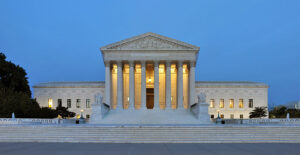
The Supreme Court opened its new term Monday with a case that could decide whether a single city can drag America’s energy companies into court over the world’s weather. Based on the questions from the bench, several justices seemed unconvinced.
The case is Suncor Energy v. County Commissioners of Boulder County. The city and county of Boulder, Colorado, sued Exxon Mobil and Suncor Energy in 2018, arguing that the companies’ fossil fuel production and marketing helped cause climate change. Boulder wants the companies to pay for local costs it ties to heat, wildfires and other climate effects, according to CBS News and Boulder Reporting Lab.
How the case got here
The oil companies tried to move the lawsuit to federal court or get it thrown out, arguing that federal law covers pollution that crosses state lines. They lost. In 2025, the Colorado Supreme Court let Boulder’s case go forward, Boulder Reporting Lab reported.
The question now is simple to state: can a local government use state law to win damages for a global problem, or does federal law block that?
The answer reaches far beyond Colorado. Colorado Newsline reported that more than 30 similar lawsuits have been filed around the country. CBS News described Boulder’s case as one of dozens brought by states and local governments in state courts.
What the justices said
Chief Justice John Roberts pointed to what could happen if Boulder wins. “Presumably if you prevail, the next day, a municipality in every single state will file a lawsuit, probably copy your pleadings,” he said, according to Colorado Newsline.
Justice Brett Kavanaugh noted the court has repeatedly said federal law governs pollution that crosses state lines. “We don’t have to reinvent the wheel,” he said. The Daily Caller reported that Kavanaugh cited “a wall of precedent” against applying state tort law to interstate pollution. The Deseret News reported he warned that suits like this could leave “any manufacturer, any business” open to being sued.
Other justices pushed back on the companies. Justice Amy Coney Barrett questioned their reading of a Clean Air Act provision, noting it “doesn’t say authorize; it says preserve,” according to the Daily Caller. Justice Elena Kagan pressed for precedent supporting the companies, and Justice Ketanji Brown Jackson called the court’s review “premature,” per CBS News.
Justice Samuel Alito did not take part. CBS News reported that he recused without giving a reason, leaving eight justices to decide.
Who argued what
Kannon Shanmugam, representing the companies, warned that if Boulder’s claims go forward, “some 90,000 municipalities across the country will have the ability to make national and international energy policy,” the Daily Caller reported.
Kevin Russell, representing Boulder, argued that states have long been able to provide remedies for injuries inside their borders, even when the conduct causing those injuries happened elsewhere.
The Trump administration sided with the energy companies. Principal Deputy Solicitor General Sarah Harris argued the suit “egregiously exceeds constitutional limits on state authority,” according to the Daily Caller.
Utah Attorney General Derek Brown traveled to Washington to watch. He told the Deseret News the real question is whether Congress decides energy policy, “or does one state get to impose through litigation their policies on 49 other states?”
A decision is expected by the end of June 2027.
Why it matters to your wallet
Energy companies don’t pay damages out of thin air. If dozens of cities can win money in state courts, those costs land on the price of gasoline, diesel, heating oil and everything that moves by truck. The Deseret News reported that billions of dollars in potential liability are at stake.
Boulder’s mayor, Aaron Brockett, said the city’s climate costs “cannot all simply be passed onto our residents and taxpayers,” according to Boulder Reporting Lab. The problem is that a judgment against energy producers would be passed on to everyone else’s residents and taxpayers instead.
The bottom line
Energy policy for the whole country should be set by Congress and federal agencies that answer to voters, not by a county commission and a state court jury in one corner of Colorado. That is the heart of the case, and it is why Roberts and Kavanaugh kept returning to the flood of copycat suits that would follow a Boulder win.
Supporters of these lawsuits say they only want communities to be paid for real costs. But the remedy they are seeking would turn every courthouse into a back door for climate regulation that activists could never pass through Congress.
The justices sounded skeptical, but nothing is decided until next summer. If the court sides with Boulder, expect the lawsuits to multiply and the bill to show up at your pump.
Sources
- U.S. Supreme Court justices appear skeptical of allowing Boulder climate lawsuit to proceed (Colorado Newsline)
- Supreme Court Split On Making Oil Companies Pay For Climate Change, Oral Arguments Suggest (Daily Caller)
- Supreme Court hears arguments in climate case that could impact Utah (Deseret News)
- Supreme Court wrestles with energy companies’ bid to block major climate-change lawsuit (CBS News)
- Boulder’s climate lawsuit reaches Supreme Court, with cases nationwide at stake (Boulder Reporting Lab)